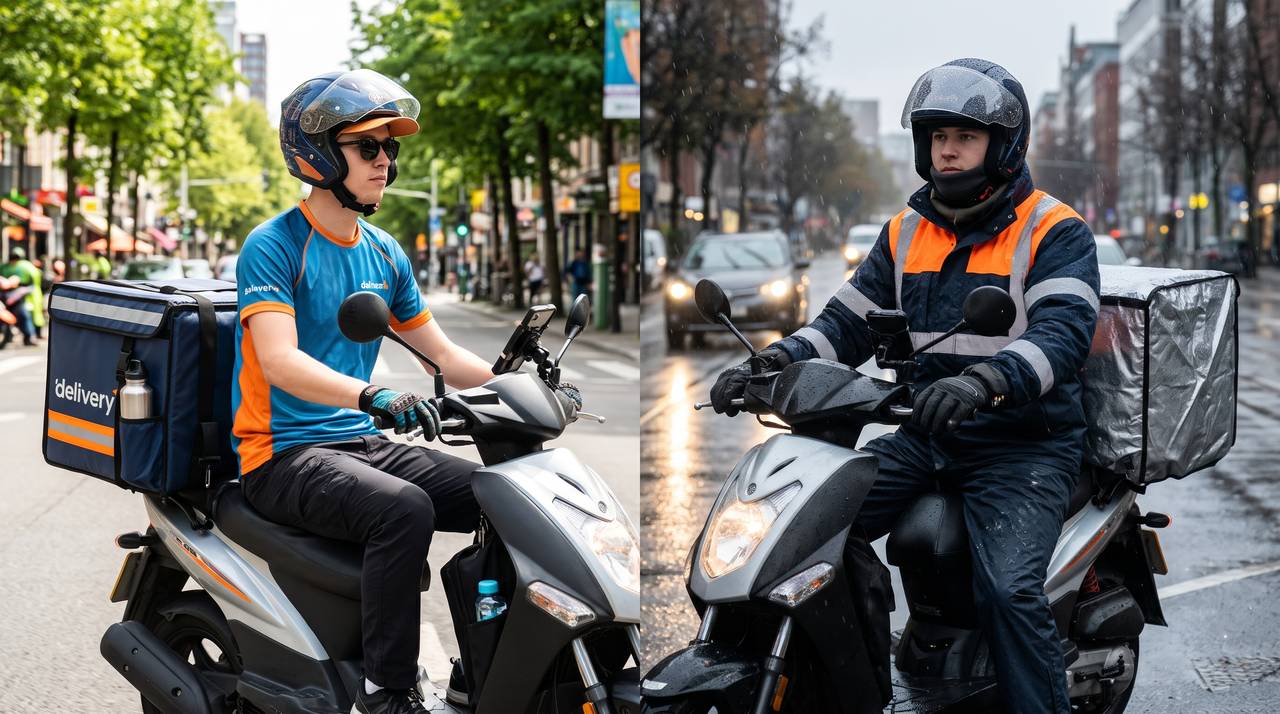
Most courier kits are designed once and then expected to work all year. In practice, the gear that is right for a dry October evening is wrong for a January downpour or a July afternoon at 40°C. When kit does not match the weather, riders improvise: they wear their own jackets over the uniform, skip the branded layer, or log off when conditions turn. That costs you visibility on the street, brand consistency and, on the worst days, riders on the road.
This checklist is for operations and procurement teams who equip delivery fleets. It covers the core kit every rider needs all year, what to add for each season, and how to plan the changeovers so the right gear reaches riders before the weather does.
The year-round core
Some items stay the same in every season. Get these right first, because every seasonal add-on builds on them.
- Delivery bag or box. Insulated, water-repellent and sized for the vehicle. Bike and scooter couriers usually carry a backpack; car couriers need a bag that fits a seat or boot. The bags in our courier store are all insulated, water-repellent and have reflective strips, with separate formats for bike, scooter and car.
- Base layer with your branding. T-shirts or long-sleeve tops in breathable fabric. This is the layer riders see most, so it needs enough stock in every size.
- Helmet and gloves, where your markets and vehicle types require them.
- Visibility elements. Reflective details on outerwear and bags that stay visible when a backpack is worn. If your risk assessment calls for certified high-visibility clothing, our courier uniform guide explains the EN ISO 20471 classes.
- Phone access. Pockets or mounts that riders can reach with gloves on.
Check local rules for the bag as well as the clothing. In the UAE, for example, new federal traffic regulations stop delivery riders from carrying orders in backpacks from 1 January 2027, as we covered in our article on the UAE delivery backpack ban.
Autumn and winter: rain, cold and darkness
Winter is when most kit fails. Riders are out in rain, wind and low temperatures, and in many markets a large share of evening deliveries happen after dark.
Rain protection. A waterproof outer shell is the most important winter item. In Europe, protective clothing against rain is tested to EN 343, which Fristads notes was replaced in 2025 by EN ISO 24232 with the same content, pictogram and classes. Garments are rated on two scales: resistance to water penetration (class 1 to 4) and breathability, measured as water vapour resistance (class 1 to 4). In both, class 4 is the best. Couriers work hard between drops, so breathability matters as much as waterproofness: a jacket that keeps rain out but traps sweat leaves riders cold and wet anyway. When you compare suppliers, ask for both ratings, not only "waterproof".
Thermal layering. Rather than one heavy winter jacket, plan layers riders can add or remove: base layer, fleece or insulated mid-layer, and the shell. Riders warm up while riding and cool down while waiting at a restaurant, so layers they can adjust work better than a single thick coat.
Accessories. Neck warmers, beanies that fit under a helmet, waterproof gloves and overtrousers for bike and scooter couriers. These are small items, but they are often the first things riders buy for themselves when the company does not supply them, and those purchases rarely carry your brand.
Bag rain covers. A rain cover keeps the bag and its contents dry and keeps reflective strips clean and visible.
Darkness. Shorter days mean more riding in low light. Check that reflective elements still work with winter layers on top: a reflective strip on a base layer does nothing under an unreflective jacket.
Spring and summer: heat, sun and long days
In warm markets, the main risk shifts from cold to heat. The kit needs to keep riders cool without losing your brand or visibility.
- Lightweight, breathable tops in fabrics that dry quickly. Light colours absorb less heat than dark ones, which is worth raising early if your brand palette is dark.
- Caps or sun protection that work with or under a helmet, where helmets are used.
- Ventilated bags. Look for ventilation or a design that sits away from the rider's back.
- Hydration. A bottle holder on the bag or a pocket that fits one.
- A summer weight of outerwear, or permission to ride without the jacket when visibility rules allow.
Heat rules can also change when and how riders work. In the UAE, the Ministry of Human Resources and Emiratisation bans outdoor work in direct sunlight from 12:30pm to 3:00pm every day between 15 June and 15 September, and requires employers to provide shaded rest areas, drinking water and cooling, according to Gulf News. If you operate in markets with rules like these, plan your summer kit and rider support together.
One identity, several weights
If your fleet spans several climates, a single all-weather kit will be too hot in some markets and too thin in others. The approach that works is one brand identity with separate seasonal weights: the same colours, logo placement and silhouettes, in fabrics suited to each climate. Our FAQ describes this as shared brand language with climate-adapted SKUs. For Carrefour, it meant a modular design system with core silhouettes that adapt across climates and a layered branding approach, so new markets could launch without a redesign.
Two practical rules help:
- Put the brand on every outer layer. If the jacket covers the branded T-shirt for half the year, the jacket needs the branding too.
- Keep sizing consistent across weights. A rider who is a medium in the summer top should be a medium in the winter shell.
Plan the changeover before the weather turns
The hardest part of a seasonal kit is not the design. It is getting the right items to every rider at the right time. Winter gear ordered when the first storm arrives reaches riders weeks too late.
- Work back from the first cold or hot week in each market, not from a single company-wide date.
- Forecast by size, using what riders actually ordered last season. Running out of medium shells in November is a common and avoidable problem.
- Stock close to riders, in each market or region, so seasonal items can ship quickly.
- Make ordering simple. Hub managers or riders should be able to order seasonal items themselves, rather than requesting them by email or spreadsheet.
- Track what was issued. Know which riders have which items, so you can plan replacements and returns.
Branded ordering eShops and inventory dashboards, like those in our software service, are built for exactly this: one view of stock, orders and replacements per market.
Seasonal courier gear checklist
| Season | Item | Check before ordering |
|---|---|---|
| All year | Delivery bag or box | Insulated, water-repellent, reflective, fits the vehicle, meets local rules |
| All year | Branded base layer | Breathable, enough stock in every size |
| All year | Helmet and gloves | Required in this market and for this vehicle type? |
| Autumn/winter | Waterproof shell | Water penetration and breathability classes (EN 343 / EN ISO 24232) |
| Autumn/winter | Mid-layer | Can riders add and remove it during a shift? |
| Autumn/winter | Accessories | Neck warmer, helmet-compatible beanie, waterproof gloves, overtrousers |
| Autumn/winter | Bag rain cover | Keeps reflective strips visible |
| Spring/summer | Lightweight top | Quick-drying fabric, colour that does not trap heat |
| Spring/summer | Sun protection | Cap that works with a helmet where needed |
| Spring/summer | Hydration | Bottle holder or pocket on the bag |
| Every changeover | Stock and sizing | Forecast by size and market, stocked before the weather turns |
Seasonal kit works best when design, stock and distribution are planned together. If you are building or refreshing a courier kit for several climates, start with our design service or contact us to talk through your fleet.