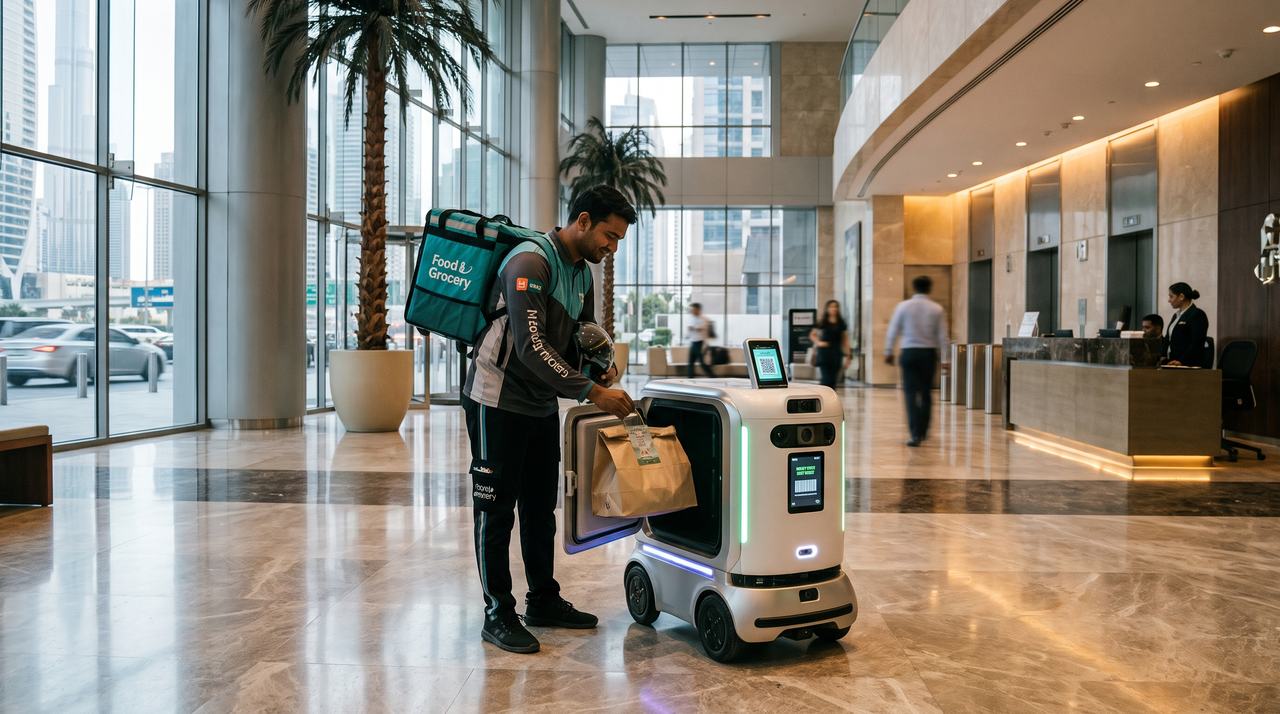
Most of the talk about delivery robots is about streets and sidewalks. Dubai's newest programme is about what happens after the rider arrives.
What happened
On 19 November, at Dubai Future Week, Dubai Future Labs, part of the Dubai Future Foundation, launched the Robots Indoor Logistics Program. Eight delivery and logistics companies signed up: talabat, Keeta, Deliveroo, Careem, Quiqup, EMX, Aramex and noon.
The idea is simple. A courier hands food, groceries or a parcel to a robot at the building entrance, and the robot carries it the rest of the way to the customer's door. The first phase will equip 100 buildings to accommodate robot deliveries by 2029. The buildings haven't been named yet.
Khalifa AlQama, Chief of Research, Development and Innovation at the Dubai Future Foundation, said the aim is to make autonomous services part of everyday urban life. Keeta's UAE general manager said indoor robots could also support delivery riders.
Why the last stretch matters
Anyone who has run a delivery fleet in a city of towers knows where the time goes. Parking, signing in at security, waiting for a lift, finding the right floor and the right door. That last stretch can take as long as the ride itself, and it is the part of the job a rider has the least control over.
Take it away and the rider is back on the road sooner. The same fleet can complete more orders in the same hours, without adding a single rider.
What changes for teams on the ground
The robot doesn't remove the rider. It adds a handover. Today, an order usually stays in one bag with one person from the restaurant or store to the customer. Under this model, it changes hands at the lobby.
That makes three practical things matter more:
- The bag and the seal. If an order is passed from a rider to a robot, the packaging has to protect it, keep its temperature and show it hasn't been opened.
- The record of who held it last. When something arrives late, cold or at the wrong door, operators need to know whether the problem happened before or after the handover.
- Training at the entrance. Riders need a clear, quick routine for handing over, in every building, at every hour.
The bottom line
The programme brings competitors onto the same building infrastructure, the way they already share roads and lifts. Its pace will be set by landlords and developers as much as by delivery apps. For anyone running teams on the road, the lesson is the same either way: every new handover is a new point where an order can go wrong, so plan for it before it arrives at your lobby.